Proposed Budget
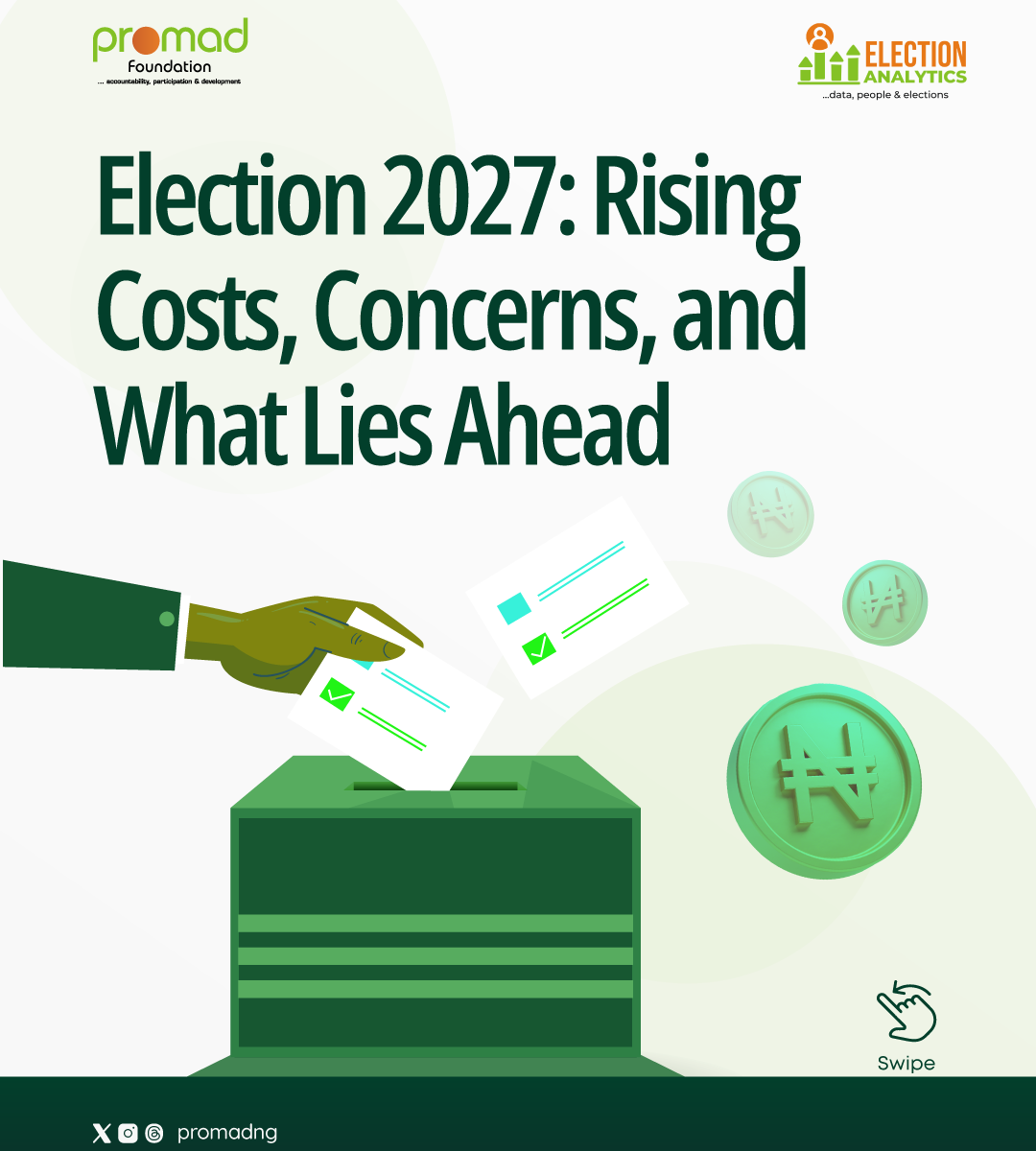
Nigerians now know the projected cost of electing their new leaders in 2027. On Thursday, 12 February 2026, INEC Chairman, Prof. Joash Amupitan, presented a proposed budget of ₦873.78 billion for the 2027 general elections before the Joint Committee of the Senate and House of Representatives on Electoral Matters. While this proposal marks a key milestone in the planning, approval, and appropriation process for the country’s next electoral cycle, the projected figure underscores the scale of resources required and raises important questions about efficiency, fiscal impact, and how these funds will translate into a credible and seamless voting experience for Nigerians.
Breakdown of 2027 Proposed Budget
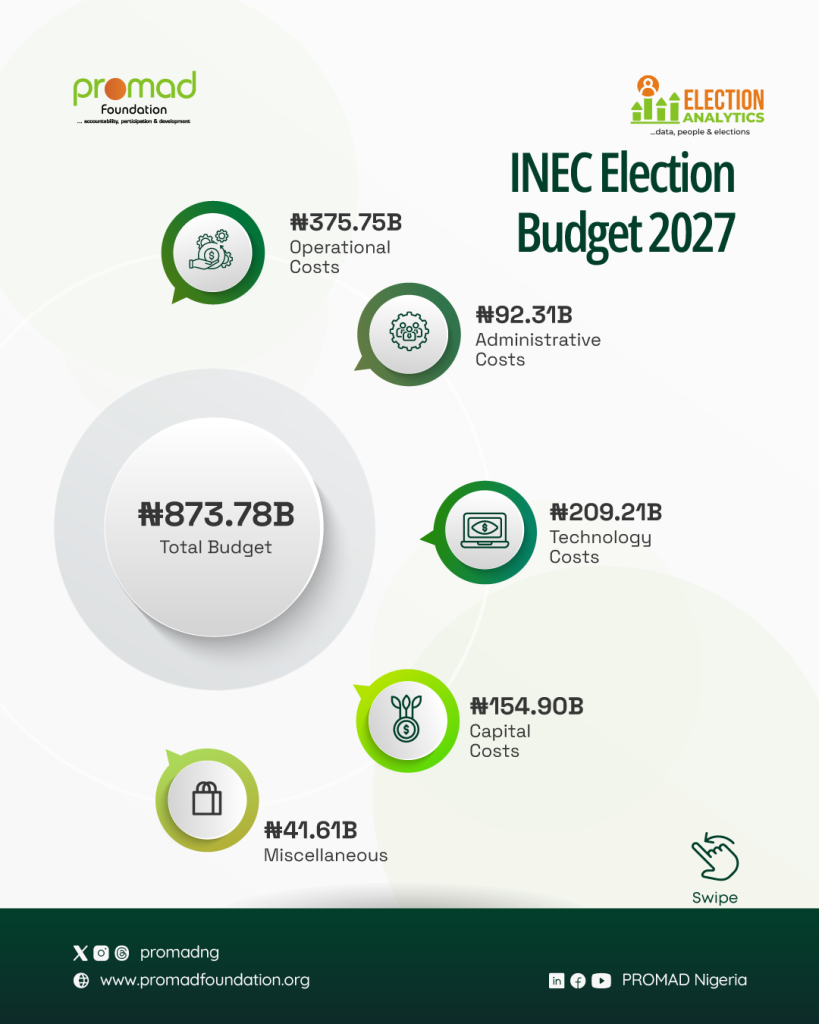
PROMAD’s analysis of the proposed budget shows that INEC has divided its planned spending into five core areas: Election Operations, Election Technology, Capital Costs, Administration, and Miscellaneous expenses. ₦375.75 billion (about 43%) has been earmarked for Election Operations, while ₦209.21 billion (approximately 23.9%) will be used for Election Technology. The remaining allocations—₦154.90 billion (17.7%), ₦92.31 billion (10.6%), and ₦41.61 billion (4.8%)—account for Capital Costs, Administration, and Miscellaneous expenses, respectively, completing the overall distribution of projected electoral spending.
2027 Budget Compared with Previous Years
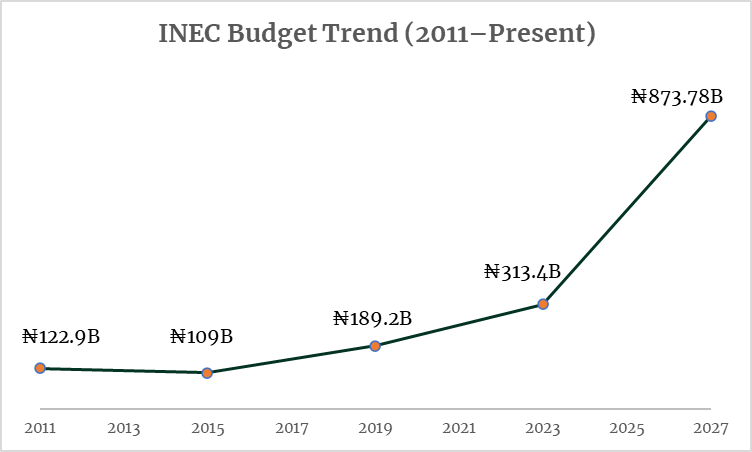
Since the return to democratic rule in 1999, Nigeria has conducted seven general elections, with costs increasing in each cycle. In 2023, amid significant economic strain, the Independent National Electoral Commission (INEC) proposed ₦355.29 billion for the polls, a marked rise from the ₦189.2 billion approved for the 2019 elections. The newly proposed ₦873.78 billion budget for 2027 represents a 146% increase compared to the 2023 allocation and surpasses the projected 2026 annual budgets of about 15 Nigerian states, highlighting the scale of resources required and intensifying debate over the cost, efficiency, and sustainability of conducting nationwide elections. In addition, the 2027 budget proposal exceeds the combined cost of the last four general elections, estimated at approximately ₦729.5 billion. This analysis, combined with reviews of previous elections, reveals that despite substantial allocations in past cycles, electoral processes were still marked by operational challenges, including logistical delays, technical disruptions, and administrative constraints, raising questions about the relationship between rising costs and actual performance outcomes.
Key Observations
- Public Confidence Stakes — The question of whether citizens still trust the electoral process is increasingly supported by turnout data. In Nigeria, voter participation has shown a sustained downward trend since the 2003 general elections, reaching historic lows in recent cycles. Despite the introduction of advanced technologies and new electoral legislation, closely contested polls have coincided with growing public scepticism and widening political divides. In the most recent national cycle, the 2023 presidential election recorded a turnout of about 27% out of over 93.5 million registered voters—the lowest since the country’s return to civilian rule in 1999. This downward pattern persisted into 2026, as reflected in the FCT Area Council elections of February 21, 2026, which saw average turnout fall to roughly 15%.
- Miscellaneous Allocation — The allocation of ₦41.61 billion for miscellaneous expenses in the 2027 proposed budget raises significant questions about transparency and accountability, particularly because the specific use of these funds is not clearly defined. This broad and undefined category makes it difficult to track spending, creating potential risks in the management of taxpayer money. Nigerians will understandably be keen to see how these funds are deployed, as greater clarity is essential to ensure public confidence, prevent mismanagement, and enable meaningful oversight of the electoral process.
- Economic Consequences — Heavy government borrowing and rising debt levels place substantial pressure on public finances in Nigeria, often necessitating increased taxation that adds significant economic strain for citizens. The proposed election spending of this scale could further drive up the prices of essential daily commodities, such as food and energy, increasing the financial burden on households. In addition, such expenditure risks conflict with the Central Bank of Nigeria’s tight monetary policy, potentially fueling inflation and undermining efforts to stabilise the economy. While conducting elections and allocating resources for them is essential, excessive or poorly planned spending can exacerbate structural economic challenges, particularly when the country’s recovery remains fragile, highlighting the tension between fulfilling democratic obligations and safeguarding economic stability.
Sustainability Concerns — By and large, the continued escalation of election costs hints at a significantly higher budget for future cycles, with projections pointing toward a trillion-naira exercise in the forthcoming 2031 election. Such swelling expenditures are likely to deepen fiscal pressures, contributing to a rising public debt burden and placing further strain on government resources. A significant portion of this spending comes directly from taxpayers’ contributions, raising critical questions about opportunity costs and the prioritisation of public funds, especially in a country where millions of citizens struggle with poverty, unemployment, and limited access to basic services. Without deliberate reforms to optimise spending and enhance efficiency, sustaining credible nationwide elections may become increasingly challenging, risking both fiscal stability and the public’s trust in democratic institutions.
The Future
Once again, INEC finds itself at the centre of public and institutional interest. With less than one year to the polls, local and international observers will be keen to assess how this substantial budget aligns with the scale and complexity of the 2027 elections. For politicians, the 2027 elections represent high stakes in terms of strategy and outcomes, while for Nigerians, the focus will be on how efficiently resources are deployed across operations, technology, and infrastructure, and how effectively logistical and administrative challenges are managed.
Close monitoring will track whether voters experience a seamless and credible process, including timely access to polling units, accurate result transmission, and overall transparency and integrity. The translation of the proposed budget into tangible electoral outcomes—such as increased voter confidence, improved turnout, and the integrity of results—will serve as a critical measure of INEC’s ability to conduct credible elections under mounting financial and operational pressures.