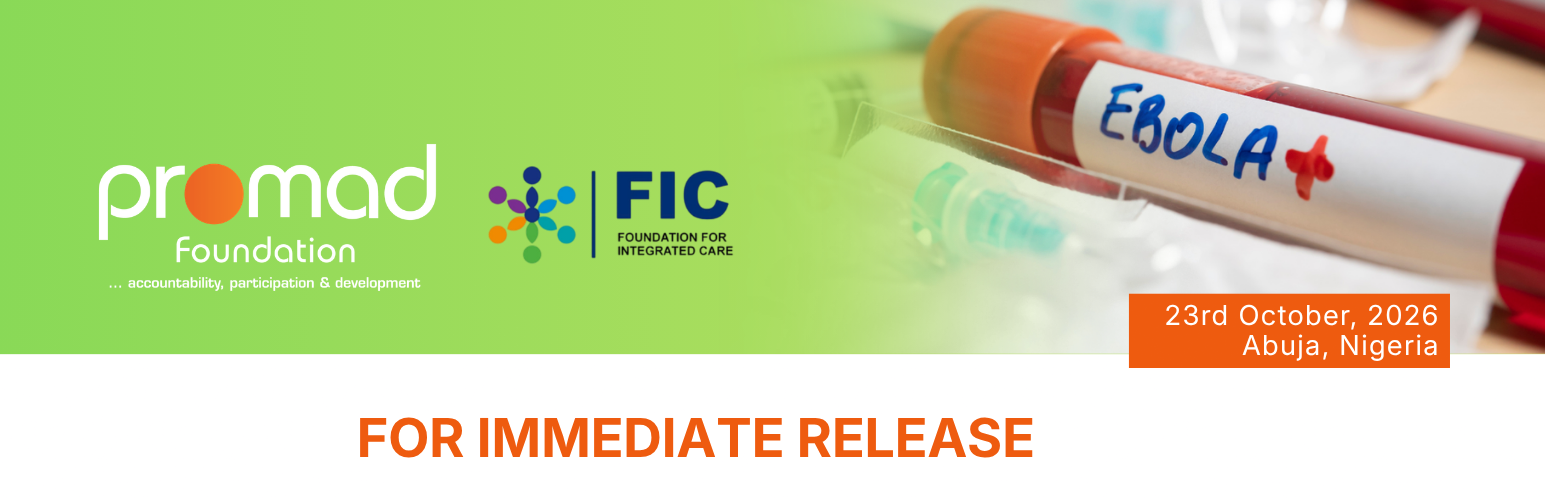
PROMAD Infotech Foundation and the Foundation for Integrated Care (FIC) have called on the Federal Government and the Federal Capital Territory Administration (FCTA) to strengthen the management of the Ebola response through coordinated public health action, effective interventions, reliable health data, transparent resource utilisation and responsible public communication.
The call follows the Federal Government’s confirmation on 20 October 2026 of an imported case of Ebola virus disease caused by the Bundibugyo virus in the Federal Capital Territory. Health authorities have activated response measures, including case investigation, contact tracing, surveillance and infection prevention and control. On 21 October, officials reported that the patient’s condition had deteriorated into multiple-organ failure. Investigations into the source of infection and potential exposures remain ongoing.
The organisations acknowledge the government’s response and the efforts of the Nigeria Centre for Disease Control and Prevention (NCDC), the Federal Ministry of Health and Social Welfare, FCTA health authorities and partners. They emphasise that sustained coordination, timely interventions and continuous assessment are essential to containing the infection and preventing further transmission.
Proper Situation Management and Coordination
PROMAD and FIC call for a coordinated, evidence-based response with clearly defined responsibilities, timely information-sharing and effective collaboration among national and FCT authorities, health facilities and partners.
Authorities should maintain active surveillance, promptly investigate alerts, strengthen contact tracing and ensure suspected cases are identified, safely isolated, tested and referred through established protocols. Regular situation updates should communicate verified epidemiological information, response progress, operational gaps and emerging priorities while protecting patient confidentiality.
Effective Interventions and Health Facility Readiness
The organisations urge relevant authorities to assess health facility readiness across the FCT, including public and private facilities. Assessments should examine healthcare workers’ preparedness, access to appropriate personal protective equipment, infection prevention and control practices, isolation arrangements, laboratory referral pathways, reporting systems and availability of essential supplies.
Identified gaps should inform targeted interventions, with responsible agencies, timelines and follow-up mechanisms established to monitor corrective action. Health workers should receive appropriate guidance and support, while public awareness activities should provide clear information on symptoms, potential exposure, prevention and when and how to seek guidance from public health authorities.
Resource Accountability and Transparent Reporting
PROMAD and FIC call for transparent reporting on resources allocated, released and spent on Ebola preparedness and response, including procurement, logistics, surveillance, infection prevention and control, and public communication.
Emergency conditions may require rapid procurement and deployment of resources, but speed must be accompanied by appropriate documentation, financial oversight and verification that supplies and services reach intended facilities and communities. Periodic reporting should demonstrate how resources are being used, identify implementation gaps and show how corrective actions are addressed.
Risk Communication and Community Engagement (RCCE) Must Be Prioritised
PROMAD Infotech Foundation and the Foundation for Integrated Care (FIC) emphasise that Risk Communication and Community Engagement (RCCE) must be central to the Ebola response in the FCT and the entire country. Beyond official announcements, authorities must provide timely, accurate and actionable information that enables residents to understand risks, protect themselves and their families, and make informed decisions.
The organisations call on the NCDC, FCTA, health facilities and response partners to coordinate public communication on prevention, potential exposure, referral pathways and response updates. Messages should distinguish verified facts from ongoing investigations, protect patient confidentiality and avoid fuelling panic, stigma or discrimination.
Nigeria’s active youth networks should be strategically leveraged as community engagement partners. Youth-led organisations, student associations and community volunteers can help disseminate verified information, counter misinformation, promote appropriate health-seeking behaviour and relay community concerns to response teams. With appropriate orientation, approved communication materials and coordination with health authorities, these networks can extend outreach, particularly among adolescents, young adults and underserved communities.
Authorities should also strengthen feedback channels for residents to ask questions and report concerns, while engaging community leaders, civil society organisations and other trusted local actors to address rumours and strengthen public trust. Communication should be inclusive, culturally appropriate and accessible to persons with disabilities and other underserved groups. RCCE activities should be linked to surveillance, contact tracing and other response operations so that community feedback informs decisions. Effective RCCE is not merely a publicity exercise; it is a critical public health intervention that builds trust, encourages cooperation and supports a coordinated Ebola response.
Conclusion
The organisations encourage residents to remain calm, vigilant and guided by verified information from the Nigeria Centre for Disease Control and Prevention (NCDC), the Federal Ministry of Health and Social Welfare (FMOHSW), and other relevant health authorities. Citizens should avoid spreading unverified information and respect the privacy of affected individuals. Anyone who believes they may have been exposed should promptly contact public health authorities for assessment and guidance.
PROMAD and FIC reaffirm their commitment to supporting the government and relevant response agencies, particularly in strengthening risk communication and community engagement (RCCE). This includes leveraging Nigeria’s active youth networks to disseminate accurate information, address community concerns and promote responsible health-seeking behaviour.
An effective Ebola response requires coordinated situation management, timely and appropriate interventions, adequately prepared health facilities, transparent and accountable resource utilisation, and sustained public trust.
Protecting lives requires effective coordination, evidence-driven action, transparent resource management and an informed, engaged public.
Signed
Joseph Akujuobi
Communications Officer
PROMAD Infotech Foundation
Signed
Anda Saddam
Communication and Media Associate
Foundation For Integrated Care (FIC)
About PROMAD Infotech Foundation
PROMAD Infotech Foundation is a Nigerian civic-tech and accountability organisation promoting transparency, citizen participation and responsive governance through data, technology and civic innovation.
About the Foundation for Integrated Care (FIC)
FIC is a Nigerian public health organisation working to strengthen health systems and improve individual and community wellbeing through integrated programmes, research, innovation, partnerships and sustainable development initiatives.